
Direct rollovers to Roth IRAs

When you retire or change employers, arranging for a rollover directly from your company retirement plan to an IRA allows you to continue to defer tax on your money until you reach age 70½. Then you’ll have to begin making annual taxable withdrawals.
However, you may be able to arrange for a direct rollover from a 401(k) or other tax-qualified plans to a Roth IRA.

Here’s why you should consider a Roth IRA rollover
With a Roth IRA, withdrawals may be completely tax free. (Earnings will be taxable, and penalties may be imposed, on withdrawals if you have not owned the Roth IRA for at least five years or if you make them before reaching age 59½. You can keep the funds in your Roth IRA for as long as you live and never have to worry about following a schedule of required withdrawals. And you can leave your Roth IRA to your heirs free of income tax.
You have to pay tax on the amount that you roll over, at regular tax rates of up to 36.9%. (State and local taxes may apply as well.) If the sum is sizeable, you may need significant resources to cover the tax bill. There’s a small silver lining in that cloud: At least you will have removed what you paid from the threat of being taxed as part of your estate.

Take the direct approach
Whichever IRA choice you make, don’t ask for a check and then set up your IRA. If you do, you’ll have only 60 days to complete the rollover. The consequences are serious if you miss the deadline. You’ll pay the tax on your distribution and, if you are under age 59½, a 10% early withdrawal penalty as well.
Additionally, your check will be less than you expect because a 20% withholding tax applies when you don’t arrange for a trustee-to-trustee transfer. If you have the cash, you can replace the amount withheld with your own funds in order to make your rollover whole, and the amount withheld will be credited toward your income taxes for the year. If you don’t, you have lost the opportunity for continued tax deferral on 20% of the amount that you have accumulated in your plan account.

Is it almost time for your rollover?
If you are planning to retire or change jobs at any time in the near future, please contact us to discuss your rollover choices and the wide variety of investment options that we can offer you. We’ll put everything in place for you, dot all the “i’s” and cross all the “t’s,” providing a seamless transition from your company retirement plan to the Rollover IRA of your choice.

© 2014 M.A. Co. All rights reserved.
Any developments occurring after January 1, 2014, are not reflected in this article.


Charity auctions

A charity-sponsored auction can be a great fundraiser; successful auctions have already raised millions of dollars. Donors provide the goods; bidders receive valuable property or services; everyone has a good time; and the charity receives the proceeds. Plus, there are tax breaks all around, right?
Not necessarily.
As with all matters of taxation, there are rules, and they can be complicated. The tax rules don’t take all the fun out of the party, but they do put a damper on it, and they mustn’t be ignored.

Rules for donors

A donation of cash to a charity to purchase items to auction generally will be fully deductible. Otherwise, the usual restrictions that apply to noncash charitable gifts apply.
Inventory. Donations of items from inventory are a common method for a business to participate in an auction. Generally, the charitable deduction will be limited to the donor’s cost.
Part gift, part sale. With very valuable property, such as automobiles, the charity may purchase the item to be auctioned. There is no deduction for the business unless the purchase was a bargain sale, in which case the deduction is limited to the bargain element.
Ordinary income property. The charitable deduction is limited to the donor’s tax basis in the property.
Tangible personal property. Because the property will be sold by the charity, not used by it in the course of its charitable mission, the deduction is normally limited to the taxpayer’s basis in the donated property, not its fair market value.
Capital gain property. A donation of capital gain property may be deductible by the donor at its full fair market value. Unfortunately, such property typically is not very attractive as auction property.
Depreciated property. If the fair market value of donated property is less than its tax basis, the charitable deduction is limited to the lower figure.
Services. Professional services can be an excellent item for auction. Donation of services for an auction yields no charitable deduction at all.

Rules for bidders

One who purchases something at a charitable auction may have the impression that, because the check is made out to the charity, the full amount is deductible as a charitable gift. Not so. There is no charitable gift unless the amount paid exceeds the fair market value of the property purchased. What’s more, there is a presumption that the amount paid for the item fairly represents its value, and that there is no gift. It’s up to the taxpayer to prove otherwise.
Example: An unusual bottle of wine from a local winery is being auctioned by Charity. The fair market value of the item is estimated to be $250.
Tom bids $150 for the wine. If his is the winning bid, there will be no charitable deduction—he has received a bargain. Dick’s bid of $250, the market value, similarly generates no deduction. A winning bid of $400 by Harry will secure for him a charitable deduction, but only for $150, the excess of the bid price over the fair market value.

Rules for the charity

Sponsoring charities have tax responsibilities associated with their auctions as well. The charity should provide advance estimates of fair market value for each item being auctioned. Receipts provided to successful bidders should identify the item, note the amount paid and include an estimate of the fair market value.
Donors must file Form 8283 and have a qualified appraisal for contributions of property worth more than $5,000, and the donee charity also must sign the form and acknowledge its own reporting requirements. If the property is sold within three years (as auction property almost certainly would be), the charity must file Form 8282 to report the sale. The purpose of the filings is to keep the amount claimed as a deduction and the amount realized by the charity in harmony.
A charity sponsoring an auction should take steps to make certain that both donors and bidders are not overestimating the tax benefits of their participation. Clearing the air early can avoid misunderstandings and hard feelings down the road.

© 2014 M.A. Co. All rights reserved.
Any developments occurring after January 1, 2014, are not reflected in this article.


Beyond ordinary insurance

Life insurance is surely one of the most versatile and important tools in estate planning. Not only can it provide for a family’s welfare in the event of the untimely death of the breadwinner, but insurance proceeds also can pay estate taxes, leaving legacies intact for the heirs.
The drawback to using life insurance to pay estate taxes is that the insurance death benefit itself is included in the estate and, therefore, increases the amount of tax the estate must pay.
Fortunately, this situation is only true if the decedent were the owner of the insurance policy. When the policy belongs to a beneficiary or a third party, its proceeds never become part of the estate. To accomplish this, the decedent must have surrendered every vestige of ownership at least three years prior to the date of death.
This can be done simply by turning the policy over to a trusted person. Annual gifts can be made to that person to cover the premiums. However, the new owner will control the policy. He or she can change beneficiaries, neglect to make premium payments, even surrender the policy for its cash value.
Insurance can provide for the survival of a closely held business. Suppose that one child works in the business and is best qualified to run it, but the business is the estate’s major asset. An insurance policy can provide fair shares to the other heirs, leaving the business child to manage the enterprise without interference.

Insuring two (or more) lives
When an estate passes to a husband or wife, no tax is due. However, upon the survivor’s death, the IRS may claim a substantial share of large estates. Married couples can provide for payment of estate taxes most economically with second-to-die, or survivorship, life insur¬ance. Because the death benefit is payable only on the death of the second spouse, this type of policy carries a lower premium than a single policy—and much lower than two individual policies. Savings of 50% or more may be possible, depending on age and insurability.
The insurance industry also offers first-to-die policies, which cover two or more lives but pay only upon the first death. A working husband and wife can use this type of coverage to ensure that money to replace lost earnings will be available to the survivor and the children.
First-to-die insurance also can be useful in protecting a family business or a business partnership. It can supply the extra cash needed for a business to recover from the effects of a key member’s death. Or the insurance can provide partners or family members with the money to complete a buy-sell agreement.

Choosing a policy
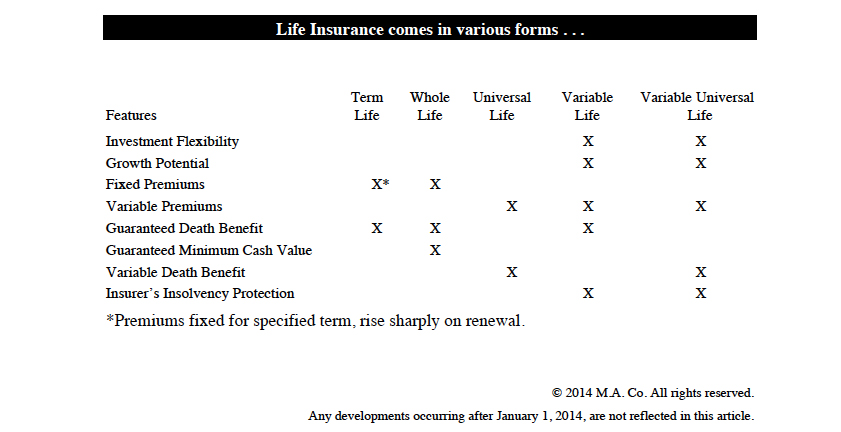
Today life insurance is offered in several different packages, each with its own advantages and disadvantages. The table here summarizes the features of the major types. Premiums can vary widely—as can the solvency of insurance companies. So it pays to shop, and to ask questions.

Insuring a business
In addition to life insurance, a business owner or professional needs to insure against a wide range of risks. Of course, the needs of each business are unique. Coverages should be reviewed periodically to ensure that continuation of the business is not at risk.
Property insurance protects against fire and smoke damage, but owners may also need to consider the possibility of losses from floods, hurricanes, earthquakes, building collapse and other unforeseen events. Such disasters usually bring extra costs—such as cleanup, storage, rentals and repairs—that can be covered by insurance. And policies are available to cover the cost of lost business.
Liability insurance can simply cover persons injured on the business premises or by its employees. Professional liability insurance, also known as “errors and omissions” or “malpractice” insurance, is available for architects and engineers as well as doctors, lawyers, accountants, brokers and other licensed professionals. And an umbrella policy can cover large liabilities after the basic coverage maxes out.
And that just may be the beginning of the insurance needs of a going business. Insurance may cover employee bonding and employee dishonesty. Workers’ compensation is mandatory, and health insurance may be essential in attracting and retaining qualified employees. Now it’s even possible to insure commercial receivables.
Many insurance companies also offer a special combined policy known as a business owner’s policy (BOP). Although not available to certain types of business, such as auto repair shops and restaurants, BOPs can offer small businesses comprehensive protection at a price well below the cost of buying the most important coverages separately.

boi


Beware of financial fraud: “phishing”

The Financial Industry Regulatory Authority (FINRA), formerly the National Association of Security Dealers, continues to warn investors and consumers about “phishing,” a scam that uses spam e-mail to lure investors into revealing bank or brokerage account information, passwords or PINs, or other types of confidential information. Often the e-mails falsely claim to be from brokerage firms, banks or other services that investors are likely to use.
According to some estimates, scam artists are able to convince up to 5% of e-mail recipients to respond to them. And, alarmingly, the number and sophistication of phishing scams are continuing to increase dramatically, according to the “anti-phishing work group” (www.antiphishing.org).

Here’s what to look for
Scam e-mails may use the names of real people, or legitimate-looking addresses, authentic-looking logos or graphics, links to pages of a bona fide Web site and official-looking fine print or references to laws. This seeming authenticity lures the investor into providing sensitive information, usually by requesting that he or she send a reply e-mail or click on a link to a Web site that mimics a legitimate site.
To lower an investor’s guard, he or she may be told that: an account will be closed unless information is updated; the investor’s identity must be verified because the account is being used by a third party in violation of the law; because of a technical update, the account must be reactivated; or recent law changes require users to identify themselves.

How to protect yourself
FINRA offers several tips, developed by the Federal Trade Commission, to help prevent you from becoming a victim of phishing or other online identity theft:
• If you receive an e-mail that warns you, with little or no notice, that an account of yours will be shut down unless you reconfirm your billing information, do not reply or click on the link in the e-mail. Instead, contact the company cited in the e-mail using a telephone number or Web site address that you know to be genuine.
• Avoid e-mailing personal and financial information. Before submitting financial information through a Web site, look for the “lock” icon on the browser’s status bar. It signals that your information is secure during transmission.
• Review credit card and bank account statements as soon as you receive them in order to determine whether there are any unauthorized charges. If your statement is late by more than a few days, call your credit card company or bank to confirm your billing address and account balances.
• Keep your personal and financial information secure online. Make certain that your computer system is up to date with the latest security patches and use antivirus and spyware detection software. Firewall software should thwart intruders from getting access to your PC over a network. Never download software or files from an unknown source.
• Report suspicious activity to the FTC. Send the actual spam to uce@ftc.gov. If you believe that you’ve been scammed, file your complaint at www.ftc.gov, and then visit the FTC’s Identity Theft Web site (www.ftc.gov/idtheft) to learn how to minimize your risk of damage from identity theft.
__________________

You can find more information about phishing or other identity-theft scams by reviewing the investor alerts available at: http://www.finra.org/Investors/ProtectYourself/InvestorAlerts/index.htm.