
Education funding

For those who are accumulating funds for a child’s or grandchild’s education expenses, there was good news in the American Taxpayer Relief Act of 2012, which was passed to avoid the “fiscal cliff” as this year started. The tax code provisions for the Coverdell Education Savings Account (ESA) were made permanent, removing a cloud of uncertainty. These accounts may be an alternative to or a supplement to a 529 college savings plan.
Contributions to 529 plans and ESAs are not tax deductible, but there is no tax as the income builds up in the account. Distributions from the plans are tax free if they are used for qualified education expenses. The definition of what qualifies is not the same for the two approaches.

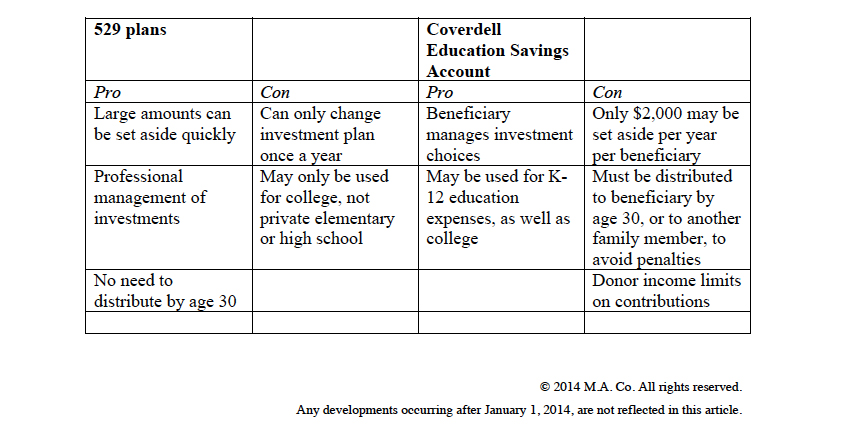
ESAs have two advantages over 529 plans. First, qualified expenses are not limited to higher education, as with the 529 plan, but may also include tuition at private school as early as kindergarten. Second, where 529 plans are typically limited to just a few investments choices, with the money managed by the plan sponsor, there are no similar limitations for ESAs.

However, there are ESA disadvantages to consider also, where the 529 plan is superior. Most importantly, no more than $2,000 per year per student may be contributed to an ESA. Second, contributions must end when the beneficiary reaches age 18. Therefore, no more than $36,000 total may be set aside for one student, which almost certainly will fall far short of the financial need. Still, having a dedicated capital source that is growing tax free as one begins higher education is nothing to sneeze at.

A third problem is that contributions to ESAs are not permitted for those whose income is too high—modified adjusted gross income of $110,000 for singles, $220,000 for a married couple. No similar limitation applies to the 529 plan.

Successor beneficiaries
What if the beneficiary decides against college? The ESA accumulation may be rolled into another ESA for a family member of a beneficiary, or an new beneficiary may be designated for the 529 plan. The new beneficiary must be of the same or higher generation as the original beneficiary.
The ESA must be distributed by the time the beneficiary reaches age 30, or within 30 days after that date. The distribution may be in the form of a rollover to another family member. Amounts not rolled over and not used for qualified expenses are included in taxable income, and a 10% tax penalty applies. No such age limits apply to the 529 plan.

Start early
As valuable as the tax advantages of ESAs and 529 plans may be, the biggest advantage is starting early. The sooner one begins setting aside funds for a college education, the more time that capital has to grow into something significant.
ef


Do you have unclaimed property?

It might be a dormant bank or investment account, an individual stock, or an insurance check. It could be unused travelers’ checks or even a balance on a gift card.
Today some states with burgeoning deficits, hunting for sources of easy revenue in hard times, are becoming more aggressive in scooping up certain property when there’s been a dearth of activity in connection with it. What is scooped up can turn out to be no small line item in a budget: For example, seized property accounted for the third-largest source of revenue in Delaware in its last fiscal year.
What a state considers to be the necessary period of inactivity to permit seizure of property may surprise you. It’s often five years, but the trend is downward, and is as little as three years in some states.

Reclaiming seized property
Theoretically, states take possession of “abandoned property” to keep it safe until claimed, and they are required to seek out its owners. Some states take an aggressive approach to attempting to find owners and return their property. Others are relatively passive, so results vary. The percentages returned can run from nearly 50% (Iowa) to single digits (Delaware). An owner who discovers that property has been seized always can step forward and file with the state to reclaim it. But proving ownership generally requires filling out a great deal of paperwork—and then waiting, adding to the time that the asset doesn’t earn interest or appreciate in value as it might if the state hadn’t stepped in. If the property is stock or jewelry (typically, from a safe deposit box), it may be sold shortly after acquisition by the state.
There’s no time limit as to when an owner can claim his or her property. Heirs, in most cases, also have a right to make a claim, although that may prove especially difficult and time consuming.

Review and research
To avoid any unpleasant surprises, make small deposits to or withdrawals from accounts for which there has been no recent activity. Check up on accounts that grandparents or others may have opened for your children for college. And when you have joint accounts with senior family members who are not likely to have made any transactions recently, find out when the last one took place.
Visit www.missingmoney.com, the Web site of the National Association of Unclaimed Property Administrators. It’s a very practical and simple way to find out if there is money owed to you or your family. Unfortunately, not all states are in the NAUPA database, although more are joining, and the number is approaching 40. (To find out if your state participates go to www.missingmoney.com/Main/StateSites.cfm.)
But even if your state isn’t in the database, it’s still worth a visit to the Web site if you have lived in other states over the years. You’ve nothing to lose, and who knows how much to gain.

© 2014 M.A. Co. All rights reserved.
Any developments occurring after January 1, 2014, are not reflected in this article.


Donation hazards

A recent Tax Court decision illustrates some of the tax headaches that can accompany making a major donation.
John and Susan Crimi owned a considerable amount of real estate in New Jersey. They received offers from a number of developers who hoped to develop homes on certain vacant parcels. To be more confident about the value of the land, the Crimis had an appraisal prepared in 2000. It found that if the land were subdivided into building lots, it would be worth over $45,000 per acre, or $2.95 million overall.

At the same time, local municipalities and conservation groups indicated an interest in obtaining the land for a nature conservancy. However, they did not have enough cash to pay the fair market value of the property.
In October 2003 the Crimis entered into a bargain sale with the county, selling the property for $1.55 million. The deal was completed in July 2004. The Crimis claimed the difference between the fair market value and the proceeds, $1.4 million, as a charitable contribution over the next two tax years.

The IRS challenged the gift on two grounds. First, the Service felt that the property was not worth $2.95 million, reducing the value of the charitable gift in turn. Second, for gifts valued at more than $500,000, the taxpayer is required to attach Form 8283 to the tax return and include a “qualified appraisal.” A qualified appraisal values the property on the date of the transfer; the appraisal done in 2000 would not be qualified under the technical requirements of the tax code. Failure to meet the qualified appraisal requirements bars the charitable deduction regardless of the underlying values.

The Crimis took the matter to the Tax Court. Two experts were called to testify to the value of the property on the date of the gift, and new appraisals were done. The IRS expert found the value to be $660,000, which was less than the cash received. The taxpayers’ expert posited a value of $3.7 million. On the whole, the Tax Court favored the approach taken by the taxpayers’ expert, subject to some downward adjustments.
More importantly, the Tax Court accepted the taxpayers’ paperwork on the donation that accompanied their tax return. The Court did not reach the question of whether the appraisal met all technical requirements, but it held instead that the Crimis had reasonably relied upon the expertise of tax professionals, with whom they had worked for 20 years. The charitable deduction for the donation of the land was sustained.
The moral of this story may be that no good deed goes unpunished. The Crimis no doubt feel vindicated by their Tax Court victory, but had they known that a donation of land to the town would trigger a costly, major fight with the IRS, they might have opted for the simpler approach of selling to a developer.

© 2014 M.A. Co. All rights reserved.
Any developments occurring after January 1, 2014, are not reflected in this article.


IRS’ “dirty dozen”

Each year the IRS alerts the public to the 12 worst tax scams that have been brought to its attention. The list changes slightly from year to year, and there never seems to be a problem coming up with candidates.

Identity theft. This is the number one problem, as identity thieves have been known to file false tax returns to obtain fraudulent tax refunds. The first tip-off for the taxpayer may be a note from the IRS that more than one tax return has been filed. Reportedly, the IRS screening procedures in 2011 protected more than $1.4 billion from getting into the wrong hands.

Phishing. Scammers send e-mails that purport to be from the IRS, hoping that an unsuspecting recipient will open it or an attachment. This can lead to identity theft. The IRS never initiates contact via e-mail.

Return preparer fraud. An estimated 60% of taxpayers now find their returns so complicated that they have to pay a professional to help them file. Some tax return preparers are fraudsters. Bad signs: promises of larger than normal refunds; failure to give you a copy of the return; charging a percentage of the refund as a preparation fee.

Hiding income offshore. A major crackdown on foreign accounts has been accompanied by a voluntary disclosure program, to permit taxpayers with offshore accounts to resolve their tax liabilities. Some $3.4 billion was collected under that program in 2009, $1 billion so far from a second round conducted in 2011.

“Free money” from the IRS and tax scams involving Social Security. The targets of these scams are low-income individuals and the elderly. Flyers have been appearing in some churches around the country.

False or inflated income and expenses. Interestingly, some taxpayers are now claiming income that they have not earned, in order to maximize their refundable credits. Some are inappropriately claiming the fuel credit that is available to farmers and others who use fuel for off-highway business purposes.

False 1099 refund claims. Contrary to the claims of some scam artists, the federal government does not maintain secret accounts for U.S. citizens that may be accessed by issuing 1099-OID forms.

Frivolous arguments. The argument that the income tax is unconstitutional is not going to work. The IRS maintains a list of frivolous arguments that will lead to additional penalties.

Falsely claiming zero wages. Some fraudsters have advised filing a Form 4852 to try to get wages adjusted down to zero. Filing this Form falsely can lead to a $5,000 penalty.

Abuse of charitable organizations and deductions. Deductions for donations of non-cash assets is a problem area.
Disguised corporate ownership. Disguising ownership is associated with money laundering and other financial crimes. The IRS is working with state authorities to identify these entities.

Misuse of trusts. This is the one that bothers us the most. Trusts are a legitimate, long-established wealth management tool. Some trusts have tax benefits; some do not. They are not a means to create deductions for personal expenses.

© 2014 M.A. Co. All rights reserved.
Any developments occurring after January 1, 2014, are not reflected in this article.