
Tax records: What do I keep?

You’ve just finish filing this year’s tax return. With a sense of relief, you set aside a copy of your return and your supporting documents. But what do you do with them then?

Of course, the first step is to keep your tax records in a safe, convenient place. You may need to refer to them for any number of reasons—for example, for future filings or when you are seeking credit. Then, too, you’ll need easy access if you face an audit from the IRS.

The following suggestions will help you compile the best and most complete records.

What to keep
First, there are the basic records that you will want to have on hand. Records of your income: Form(s) W-2, Form(s) 1099 and bank statements. Expense records should include sales slips, invoices, receipts, cancelled checks or other proofs of payment.
Among the investment records that you’ll want to keep are the following: brokerage statements, mutual fund statements, Form(s) 1099 and Form(s) 2439 (Notice to Shareholder of Undistributed Capital Gains). Keep year-end account summaries and deposit receipts for any IRA or Keogh contributions.
Your records should enable you to determine your basis in an investment and whether you have a gain or loss. Records should show the purchase price, sales price and commissions paid. They also may show any reinvested dividends, stock splits and dividends, load charges and original-issue discounts. If you have real estate investments, you’ll need to keep copies of all the regular and extraordinary expenses associated with the properties.

How long to keep it
According to the Tax Code, you are required to keep copies of your tax return and all support as long as they may be needed for the administration of any provision in the law. Typically, that means for as long as the IRS has the right to assess additional tax on your return, or you have the right to amend your return to claim a credit or refund (“the period of limitations”).
There are several periods of limitations. One is a three-year period that applies generally. Another is a six-year period that applies when you don’t report income that you should and that income is more than 25% of the gross income shown on your return. If the return is fraudulent, or you fail to file a required return, there is no limit as to when the IRS can require you to provide it with information.

Recordkeeping for homeowners
Determining your basis (cost) in your home will be extremely important in order to figure the gain or loss when you sell your home (or to calculate depreciation if you use part of your home for business purposes).
Therefore, your records should enable you to determine your basis as well as any adjustments to your basis. Your records should show the original purchase price of your home and settlement or closing costs. They also may show any casualty losses incurred, insurance reimbursements for casualty losses and postponed gain from the sale of a previously owned home.

Be sure to keep a file of bills on what improvements you’ve made to your home each year. Generally, the costs of improvements—changes that add value to your home, prolong its life or adapt it to new uses—may be added to the basis in your home. Repairs and general fix-up costs may not.

© 2014 M.A. Co. All rights reserved.
Any developments occurring after January 1, 2014, are not reflected in this article.


Tax planning goes year-round

Upper-income taxpayers have many new levies to worry about and plan for this year. Some of these arose from the compromise over the expiration of the “Bush tax cuts”; others were enacted with the Affordable Care Act, but were given delayed effective dates. Taken together, these provisions could greatly raise the reward for effective tax planning.
When the stakes are this high, it’s better not to wait until year-end to start your tax planning moves. Here we look at just one issue.

Net investment income

This year there is a 3.8% tax on net investment income above $200,000 ($250,000 for marrieds filing jointly). The tax applies to the lesser of net investment income or the amount by which modified adjusted gross income (MAGI) exceeds the threshold amount. Here’s how it works for three singles.
Example 1. Bob has $100,000 in salary and $75,000 of net investment income. No tax is due, as his MAGI didn’t cross the threshold.
Example 2. Carol has $350,000 in salary, no net investment income. The 3.8% tax does not apply if there is no investment income.
Example 3. Ted has $300,000 of net investment income, no salary. The amount over the threshold, $100,000, is subject to the new tax, so he’ll owe $3,800 on the excess, in addition to any other taxes on the investment income.

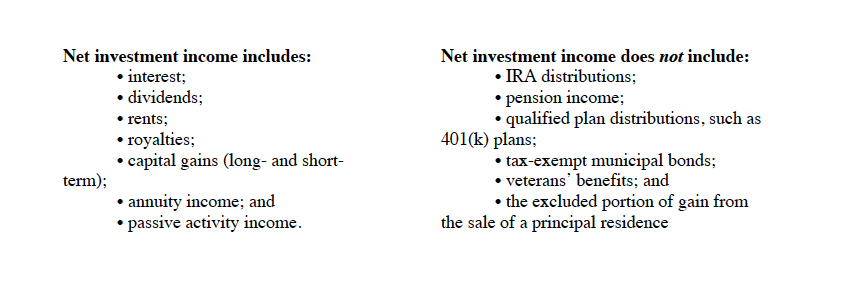
What’s in and what’s out:
What is net investment income anyway? Here’s the breakdown:

tpgyr

Income sources that aren’t subject to the new tax may push a taxpayer into the taxable area. For example, a major IRA distribution in a single year might move a taxpayer over the threshold.
Example 4. Alice has $200,000 of net investment income. So far, no 3.8% tax, because she’s below the taxable threshold. Now Alice decides to withdraw $50,000 from her traditional IRA. The withdrawal itself isn’t taxed, but it does push $50,000 of her net investment income into the taxable area.
Tax planners have come up with a number of strategies to keep exposure to the tax on net investment income under some control. For example, investing for growth instead of income gives the taxpayer a measure of control over timing the realization of income. Distributions from Roth IRAs are exempt from the tax, as is municipal bond income. Most important, spot check for exposure to the tax throughout the year, so as to avoid painful surprises at tax filing time.

© 2014 M.A. Co. All rights reserved.
Any developments occurring after January 1, 2014, are not reflected in this article.


Rollover rules

Will you be rolling over your 401(k) or other retirement money to an IRA? Or transferring your money from one IRA to another? If so, be aware that the IRS has been taking a very hard line on technicalities.

The 60-day rule
If you receive a distribution from your company plan, you have 60 days to roll it over to an IRA. If you miss the deadline, the distribution becomes taxable, and if you are under age 59 1/2 , you’ll be hit with a 10% penalty, too. The same 60-day rule applies if you choose to move money from one IRA to another.

Escape from the rule
Unfortunately, people (and sometimes even financial institutions) make mistakes. In 2002 Congress directed the IRS to carve out some exceptions to the 60-day rule so as to avoid harsh and inappropriate tax consequences.
Some of the examples in the IRS guidance were very specific—errors made by a financial institution and the inability to complete the rollover as a result of death, disability, postal errors and other similar events. One ruling waived the requirement when an individual deposited a distribution check into a savings account in the mistaken belief that the distribution was an insurance death benefit, and it allowed the “late” contribution to be rolled over without tax or penalty. Similarly, IRS granted relief when a rollover attempt failed because the individual used the wrong form, and the time lapsed for the rollover.

But recently, the Service has seemed less forgiving. The IRS refused to waive the rule for an individual who received a distribution without any guidance about taxes, withholding and her rollover option from the institution issuing the check. The IRS also refused relief when an individual mistakenly believed that all taxes had been paid on two distributions that he had received and, after learning that more taxes were owed, wanted to do a rollover after the 60 day limit had expired.

“Because the IRS has not been consistent in their rulings,” says Natalie Choate, Esq., a noted retirement planning specialist with the Boston law firm, Nutter McClennen & Fish LLP, “it’s not always clear what leads the IRS to grant or deny a waiver. Lately some of the results have been harsh.”

Avoiding the rule altogether
The 60-day rule needn’t be a concern at all, if you don’t take your retirement money from your company plan or IRA yourself. You simply arrange for a direct or trustee-to-trustee transfer. In both cases, by requesting it, the funds will move from your plan account to an IRA (or from IRA to IRA) without your need to receive the distribution in hand.
When it comes to your company plan, there’s another good reason for a direct transfer to an IRA: no withholding tax. Your employer must withhold 20% of your distribution for taxes, but this withholding is not necessary when the IRA trustee receives the money directly.

_______________

Is retirement near? Have you been thinking about choosing a new trustee for your IRA funds? Come talk to us. We’ll explain how we can make your rollover effortless and tell you about the wide array of investments that we offer our IRA customers.

© 2014 M.A. Co. All rights reserved.
Any developments occurring after January 1, 2014, are not reflected in this article.


Role of the trusted advisor

The trust advisor stands in the unique position of being a central clearing house for his or her clients. The advisor knows the client’s current financial position, the client’s business, the client’s family dynamics and has helped plan the future for the client. In many cases the trust advisor stands in the place of the client, making decisions on life changes for the client, executing plans created by the client related to family and business and investing to meet the client’s financial objectives.

Thus, the trust advisor has come a long way from the time that the client saw the trust department as the final stopping point to gather assets, pay taxes and distribute assets to the client’s family. Today, the trust advisor is in the middle of planning for the client. The trust advisor works with the client, and the client’s attorney, accountant and other advisors. The trust advisor also brings unique perspectives that the client can find nowhere else.

The trust advisor does not charge for his or her time. Therefore, the trust advisor provides a sounding board for the client that can be provided without starting up a billing clock. The advisor brings to bear his or her knowledge of the client, other situations that might relate to the client’s situation and other cases in which the advisor and the client’s professional team have worked together.

While the advisor builds his or her relationship with the client, the advisor also brings valuable experiences to help the client. Building this relationship also establishes the advisor’s knowledge of the client and the client’s goals and objectives. Then the advisor can look at questions and opportunities through the eyes of the client. The advisor provides an independent but kindred viewpoint. The advisor also stands in for the client if that person is incapacitated, unavailable or deceased.

The trust advisor also serves as a gatekeeper for other banking services, including business loans, insurance loans, mortgages, home equity loans and a host of deposit and other bank products.

Focus on clients

The trust advisor achieves his or her valued position with the client through the process of building a relationship with the client. The more the advisor meets with the client, understands the client’s goals and objectives, and learns of past decisions and events in the client’s life, then the more that advisor becomes a unique and important advisor to the client.

But this doesn’t happen in a vacuum. Client confidence does not come without earning it. Clients are increasingly more sophisticated and knowledgeable. They expect a higher level of service, and they know of other sources for services. They want accuracy and timeliness. They expect understanding and familiarity with their own unique situations. They want good investment performance. They want good communication. They appreciate communication from their advisor in anticipation of their questions and needs.

To achieve this level of service for the client, the advisor must keep organized files. It is critical that the client’s case be reviewed and detailed in these files. This analysis will include a synopsis of documents, a recap of family members and a tickler of recurring events and services. Building the file helps the advisor serve the client and provides reminders of things that need to be done to help the client.

To focus on the client, the advisor needs to work hard. The advisor needs to contact the client many more times than the client contacts the advisor. The advisor needs to establish his or her position as a valuable team member. Far from being taken for granted, the client must believe that the advisor is always thinking about ways to help the client.
With this focus, the client receives personalized service, specific to the client’s situation. The client receives valuable financial investment management services and helpful financial advice. The client has a team member who considers his or her best interests. The client has an advisor who will serve the client and other members of the client’s family.

© 2014 M.A. Co. All rights reserved.
Any developments occurring after January 1, 2014, are not reflected in this article.