
“Aging in place”

The percentage of Americans over 85 is growing steadily, and with it a new conundrum: Where will the elderly live? For a growing number of folks who are still healthy, the answer is “right at home.” According to the federal Consumer Expenditure Survey, from 1987 to 2003 the percentage of persons over age 85 living in single-family, detached homes surged from 45.7% to 62.6%, and the best guesstimate is that the figure is now about 70%.

Current conditions in the housing market may well accelerate the trend. The tradition of selling the family home for a large profit, moving to smaller quarters and keeping the savings to augment the retirement nest egg is difficult to impossible to implement in a falling real estate market.

The idea of not moving out of one’s lifelong home has been dubbed “aging in place” by sociologists. The new trend has spurred a new industry of books, videos, Web sites and consultants to help make that hope a reality. Financial independence is one core element. Adapting the home for an older resident is another. The housing and living needs of someone over 85 are markedly different from those of younger persons. Some homes may need renovations if they are to remain livable for an elderly person. A variety of changes, minor to major, can have an impact on senior life.

Basic steps
Four areas typically need to be addressed to improve a home’s livability for an older person.

Access and mobility. The biggest concern for the elderly is avoiding falls. Accordingly, the house should be inspected for slippery floors or areas where rugs or carpets can bunch up, creating a tripping hazard. Additional handrails for stairs are a good idea. Looking ahead, the house may need a wheelchair ramp, or a lift to get to the second floor.

Bathrooms. Grab bars are recommended, and toilet modifications may be appropriate. Placing a chair in the bathroom may make grooming easier. Bathtubs and showers can be modified for easier and safer access.

Kitchen. Cabinets that were once easily accessible may no longer be convenient when they involve bending or reaching. Stepstools are not a good answer. A kitchen makeover for cabinets and appliances may be needed, putting the priority on ease of use.

Lighting. A common problem facing seniors is deteriorating vision. Poor lighting can affect safety as well as the quality of everyday life. Illumination should be even, free of glare, and automated whenever possible.

If there will be a full- or part-time caregiver for the elderly person, attention will need to be paid to create privacy zones and separate living quarters.

Don’t be afraid to say “no”
Not every home is suitable to be renovated for senior life. Renovations can be too costly in some cases. Sometimes it is better to admit that a house is really designed for younger families and move to another, more appropriate house. “Aging in place” doesn’t necessarily mean “aging in the same place.”

Additional resources
To learn more about resources for the eldely, visit the National Aging in Place Council at www.naipc.org and the Aging in Place Initiative at www.aginginplaceinitiative.org. Nobody ever said that growing old was going to be easy.

© 2014 M.A. Co. All rights reserved.
Any developments occurring after January 1, 2014, are not reflected in this article.


IRS announces 2014 retirement plan limits

To make it possible for voluntary retirement savings to keep up with inflation, the various numerical limits embedded within qualified retirement plans are indexed for inflation. In October the IRS announced the numbers that will apply in 2014, as shown in the following table:

Catch-up contributions are permitted by those employees who are 50 years of age or older during the calendar year.

Saving for retirement is probably never harder than during rocky economy times. It’s those times when it is also most important.

© 2014 M.A. Co. All rights reserved.
Any developments occurring after January 1, 2014, are not reflected in this article.


What the PPACA may mean to you

One important goal of the Patient Protection and Affordable Care Act (PPACA) was to guarantee health insurance availability regardless of health status, eliminating rejections due to pre-existing conditions. The practical problem with such a guarantee is that some people may find it in their self-interest to avoid the expense of health insurance, waiting until they are really sick and buying it then. That shrinks the pool of premium payers, driving up the costs for those who do have insurance. The remedy to that problem is the individual mandate.
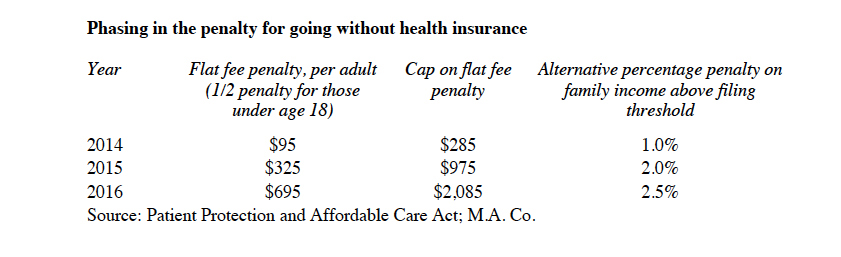
Beginning in 2014, most Americans will have to demonstrate to the IRS that they have adequate health insurance. Failure to have adequate health insurance triggers an additional income tax payment to the government. The law called the payment a penalty. Chief Justice Roberts called it a tax in order to join a majority of U.S. Supreme Court Justices sustaining the constitutionality of the PPACA. The initial penalty is relatively low, but it very roughly doubles and redoubles as shown in the table below. The penalty is the greater of a flat fee or a percentage of family income above the income tax filing threshold. A penalty payment is owed for each uninsured adult in a family, and a half penalty is owed for each child under age 18, but the flat fee is capped at three times the base penalty. That corresponds to two adults and two minor children. After 2016 the penalty is adjusted annually for inflation.

PPACA

“Family income” for purposes of the percentage penalty is the taxpayer’s modified adjusted gross income (MAGI) plus the MAGI of any other family members for whom the taxpayer claims an exemption, plus any tax-exempt interest received during the tax year. Social Security benefits not included in gross income are not counted.
Example. Assume a single taxpayer has $50,000 of MAGI and that the filing threshold is $10,000. The excess income is $40,000, so the 1% penalty in 2014 comes to $400, and the 2% penalty in 2015 would be $800. Those would be payable, as they are higher than the flat fee. Generally, the annual penalty will be capped at an amount equal to the national average premium for qualified health plans that have a “bronze” level of coverage available through the state exchanges.

Exemptions

There are nine statutory exemptions from the enforcement of the penalty imposed by the individual mandate:
Religious conscience. Members of religious sects recognized as opposed to insurance. The Social Security Administration administers a process for identifying and recognizing these religious organizations. Members will need to apply for an exemption certificate from a Health Insurance Marketplace.
Health care sharing ministry. Members of recognized health care sharing ministries.
Indian tribes. Members of federally recognized Indian tribes.
Incarceration. Those who are currently incarcerated.
Not lawfully present. Persons who are not U.S. citizens or U.S. nationals, or who are aliens not lawfully present in the U.S.
Not required to file tax returns. Those whose income falls below the income tax filing threshold. The threshold is a function of filing status, age, and types and amounts of income. Thresholds are expressed in terms of gross income. In 2012 the filing threshold for single taxpayers under age 65 was $9,750, and for married couples filing jointly (both under age 65), it was $19,500.
Short coverage gap. The penalty imposed by the individual mandate applies on a monthly basis. Someone who changes jobs and has a coverage gap of less than three consecutive months is excused from the penalty. A month of coverage is any month in which the taxpayer had health insurance coverage for a single day.
Hardship. A Health Insurance Marketplace, also known as an Affordable Insurance Exchange, may issue hardship certificates to those unable to obtain coverage.
Unaffordable coverage options. If the available coverage requires premium payments in excess of 8% of household income, it is considered unaffordable, and the taxpayer does not have to buy it.
In general, an exemption from the individual mandate will be claimed as part of filing a federal income tax return.

Senior citizens

The individual mandate applies to senior citizens, but Medicare qualifies as minimum essential coverage. Each month of Medicare participation counts toward the mandate.

Enforcement

The requirement to have health insurance begins on January 1, 2014, and will be reported to the IRS on 2014 Forms 1040 in early 2015. Much could change before then. The Obama administration already has announced that it won’t enforce the employer mandate in 2014, and there is political pressure to extend that waiver to individuals also. IRS enforcement tools have been deliberately limited by the PPACA. Specifically, the IRS is only authorized to withhold the penalty under the individual mandate from a taxpayer’s income tax refunds, which are received by roughly half of all taxpayers each year. If a taxpayer has no refund due, then current law would result in a de facto avoidance of the penalty under the individual mandate. Last year the Congressional Budget Office estimated that by 2016 about 11 million taxpayers would be subject to the individual mandate and about 6 million would choose to pay the penalty, raising $7 billion in revenue.
However, anecdotal evidence suggests that taxpayers likely will alter the way in which they withhold for taxes in order to ensure that they do not owe taxes at the end of the year, or come as close to zero as possible, in order to avoid the penalty associated with the individual mandate. In this way, taxpayers could obtain health insurance at a moment’s notice when sickness arises (due to the PPACA’s prohibition against denials due to pre-existing conditions) rather than carrying escalating premium insurance during periods of health. One of the goals of the PPACA was to dilute the insurance pool with healthy individuals who normally do not access their care, thereby reducing premium costs across the board. If a large number of normally healthy individuals avoid the penalty under the individual mandate by under-withholding, the costs for premiums will increase rather than decrease for those remaining on the insured rolls.

© 2014 M.A. Co. All rights reserved.
Any developments occurring after January 1, 2014, are not reflected in this article.


Trusts for special needs

Providing support without jeopardizing benefits

Parents and grandparents of a child with a lifelong disability, such as autism, have a special estate planning challenge. On the one hand, they want to provide the financial support that the child never may be able to provide for himself or herself. On the other hand, they want to protect the child’s eligibility for the full range of government support programs, including health care.

Distributing assets outright to to a special needs person is likely to result in a disqualification for government benefits. Completely disinheriting the child is not a good idea, because government benefits alone may not be enough. Giving property to other family members with the “understanding” that it will be used for the benefit of the special needs person may work for some families, but there are risks. For example, such assets will be vulnerable to creditors, including potential ex-spouses should there be a divorce.

The better course, for many families, is to establish a “third-party” special needs trust. A “first-party” special needs trust is one established for oneself, with one’s own assets. The assets of first-party trusts must be used to repay state Medicaid agencies that have paid for medical services. No such requirement applies to third-party trusts that are created for others.

This is a complicated area of law, and the rules vary from state to state, so the advice of a lawyer well-versed in special needs trusts will be essential.

Funding the trust

A special needs trust has to be fit into the estate plan as a whole. Very often the parents of a special needs child will provide that child with an enhanced share of the estate. For example, if there are three children, the estate may be divided 40-30-30, or 50-25-25.
Another approach is to divide the estate equally but supplement the provision for the special needs child with a life insurance policy, perhaps a second-to-die policy if both parents are living. This can be an affordable way to be confident that the special needs trust will be funded at an adequate level for the child’s entire life.

Choosing the trustee

In general, a family member should not be the sole trustee of a special needs trust. A professional trustee or a corporate trustee, such as a bank trust division or a trust company, is a better choice. The trustee will be given sole and absolute discretion in making distributions. Therefore, the trustee needs to be familiar with the legal requirements of special needs trusts and with government benefit programs. Investment management skills are a must if the trust is intended to last for many years. It’s also important that the trustee be free of conflicts of interest, which someone who is a remainder beneficiary of the trust would have.

To provide guidance for the trustee, the parents should prepare a letter that explains the purposes of the trust and the needs of the child. This can cover the child’s likes, dislikes, needs and preferences, and other information that will be essential to make the trust plan a success. Special needs organizations have prepared samples of such “letters of intent” to provide a starting point for parents taking this path.

© 2014 M.A. Co. All rights reserved.
Any developments occurring after January 1, 2014, are not reflected in this article.