
Upper-income taxpayers have many new levies to worry about and plan for this year. Some of these arose from the compromise over the expiration of the “Bush tax cuts”; others were enacted with the Affordable Care Act, but were given delayed effective dates. Taken together, these provisions could greatly raise the reward for effective tax planning.
When the stakes are this high, it’s better not to wait until year-end to start your tax planning moves. Here we look at just one issue.
Net investment income
This year there is a 3.8% tax on net investment income above $200,000 ($250,000 for marrieds filing jointly). The tax applies to the lesser of net investment income or the amount by which modified adjusted gross income (MAGI) exceeds the threshold amount. Here’s how it works for three singles.
Example 1. Bob has $100,000 in salary and $75,000 of net investment income. No tax is due, as his MAGI didn’t cross the threshold.
Example 2. Carol has $350,000 in salary, no net investment income. The 3.8% tax does not apply if there is no investment income.
Example 3. Ted has $300,000 of net investment income, no salary. The amount over the threshold, $100,000, is subject to the new tax, so he’ll owe $3,800 on the excess, in addition to any other taxes on the investment income.
What’s in and what’s out:
What is net investment income anyway? Here’s the breakdown:
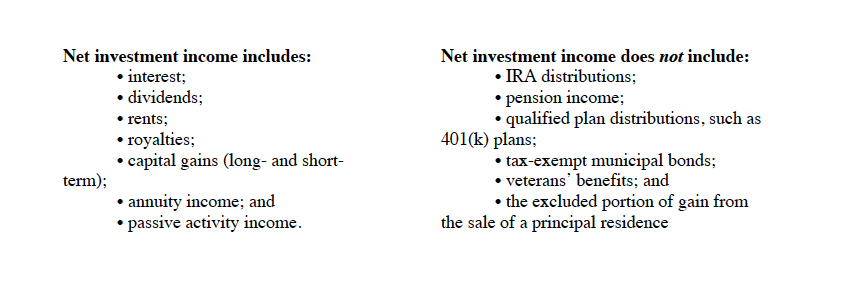
Income sources that aren’t subject to the new tax may push a taxpayer into the taxable area. For example, a major IRA distribution in a single year might move a taxpayer over the threshold.
Example 4. Alice has $200,000 of net investment income. So far, no 3.8% tax, because she’s below the taxable threshold. Now Alice decides to withdraw $50,000 from her traditional IRA. The withdrawal itself isn’t taxed, but it does push $50,000 of her net investment income into the taxable area.
Tax planners have come up with a number of strategies to keep exposure to the tax on net investment income under some control. For example, investing for growth instead of income gives the taxpayer a measure of control over timing the realization of income. Distributions from Roth IRAs are exempt from the tax, as is municipal bond income. Most important, spot check for exposure to the tax throughout the year, so as to avoid painful surprises at tax filing time.
© 2014 M.A. Co. All rights reserved.
Any developments occurring after January 1, 2014, are not reflected in this article.