
Financial strategies for widows and widowers

In a relationship, generally, one of the partners handles most of the financial planning and money issues. But what happens when the spouse who actively managed the couple’s assets and financial future is no longer the decision maker? The less experienced spouse has to step up to the plate, usually with little or no warning. Because this transfer of responsibility is often occasioned by death, disability or divorce, it can be an emotionally challenging time. Yet critical decisions concerning investments, insurance, financial and estate planning need to be made to avoid or minimize financial hardships later.
Here are some guidelines to help a novice get up to speed. Putting your financial life in order is essentially a five-step process:

• Determining your financial and estate planning objectives;
• Evaluating the continued viability of any plans in place;
• Understanding the options available to achieve your goals;
• Formulating a plan to achieve your goals; and
• Implementing the plan.

What do you have?
Begin by making an asset and plan inventory, securing existing papers that provide the information that you will need. These documents fall into two groups:

1. Financial documents—including tax returns, bank and brokerage statements, credit card records, mortgages, insurance, retirement and other employee benefits, and similar statements that have information on your assets and liabilities.

2. Legal documents such as your will, durable power of attorney, health care proxy and any trust agreements that name you as a beneficiary or trustee.

It is important to remember that both types of document may embody your estate and financial plans. For example, beneficiaries can be named in trust agreements and your will. But they also can be named in beneficiary designation forms on file with your employer (for retirement plans and other benefits), as well as banks, brokers and insurance agents. These designations are as binding as your will.
Once you have sifted through these materials, you will know the nature and extent of your assets, and how these assets will pass at your death.

Making adjustments
The next steps involve deciding whether the plan in place still makes sense and, if not, implementing needed changes. Following are the types of issues that you should consider:

• Reevaluation of income needs and investment goals to ensure that your current portfolio meets the needs of your new circumstances. For example, if you were not the primary income producer, you may want to adjust your investments to generate more income. If joint retirement is no longer an issue, your investment mix may need rearranging.

• Review of beneficiary designations in wills, trusts, bank accounts, retirement accounts and insurance policies. These must be changed to provide a new beneficiary if a spouse were previously the sole beneficiary. The same applies to designations for executors, guardians and trustees. Health care proxies and durable powers of attorney also may have to be updated to empower trusted loved ones to make decisions when you cannot.

• Use of a living trust to afford you the comfort and security of having a professional trustee manage assets during your life and ensure that they are distributed pursuant to your wishes, without getting involved in the probate process.

Children and grandchildren as beneficiaries may become more important in your planning. Issues that arise here include whether:

• A program of lifetime gifts makes sense in order to reduce your death taxes and put money in their hands for education, home purchase, etc.

• A trust should be established to provide for special needs children or the education of minor children.

• It makes sense to name children as your IRA beneficiaries so as to extend the payout period over their life expectancies and protect against poor financial decisions.

Don’t go it alone
Once you have reviewed your current plans and documents in place, and considered the issues and options, you can make informed decisions about a new plan tailored for your circumstances.
Throughout this process it is important to obtain professional guidance as you chart your course. We can offer you guidance on a wide range of investment, retirement and estate planning needs. Together with us—and with the assistance of your attorney, accountant or other professionals with whom you work—you will be able to gain the necessary knowledge about financial matters to allow you to make the decisions that are important for your future—and the future of others in your care.

© 2014 M.A. Co. All rights reserved.
Any developments occurring after January 1, 2014, are not reflected in this article.


Equity line scams

Mortgage fraud schemes have existed for years. But, as the FBI warns in its annual mortgage report issued earlier this year, a depressed housing market provides an ideal climate for mortgage fraud perpetrators to employ a variety of schemes to take advantage of the downward trend. As lending practices tighten in response to the subprime lending crisis, financial institutions are employing higher standards and fewer loans are being originated—forcing scammers to turn to alternative methods.

Moving on up
Identity theft is a key tool for use in mortgage fraud schemes. In the days of subprime mortgages, thieves could pose as people with modest incomes and obtain mortgages in their names with little documentation. Now the identities of individuals with good credit have more value. One of the newest strategies, says the FBI, involves fraudulent equity credit lines.
There are several reasons for the development. Home equity lines are reasonably easy to open once the thief has the proper financial information. The lines are often for significant sums. Even open lines of credit are vulnerable. Scammers are counting on the fact that the funds may not be accessed for an extended period of time, and that account balances on monthly statements may not be regularly verified.

How it works
Here’s a typical scenario, courtesy of the FBI:
Once a victim’s identification has been stolen, the perpetrator poses as a customer, using the Internet to apply for a line of credit. He or she manipulates the customer account verification processes, including rerouting telephone calls and forging signatures.
The perpetrator uses the account holder’s identification information to contact a financial institution and request an advance of funds on the line. Once the advance is granted, the perpetrator sends a fax to the financial institution requesting that the funds be wire-transferred to another account. On receipt of the request, the financial institution contacts the account holder using the telephone number on record to verify the transaction. However, the call actually is forwarded to the perpetrator who verifies the account holder’s information to complete the wire transfer.

A call for vigilance
The Identity Theft Assistance Center, a nonprofit coalition of financial services companies, has been especially active in trying to get the word out to homeowners about equity line scams.
Steve Bartlett, chief executive of the Financial Services Roundtable, a consortium of banking-related companies that offers financial support to the Center, recently was quoted in The New York Times as saying that victims of such schemes typically are reimbursed by the lender if a bank investigation confirms fraud. But lawyers who represent victims of identity theft say that such remedies often do not come quickly or easily.
What about “preventative medicine”? Here are three suggestions:
• Borrowers should review every regular statement as they do their banking and brokerage statements, even if there were no transactions in the period covered by the statement.
• Everyone should take advantage of the fact that each of the three nationwide consumer credit reporting companies (Equifax, Experian and TransUnion) are required to provide free annual credit reports. Watch out for offers for “free” reports that are tied to paying a monthly fee for additional services. The ways to get a no-strings attached report are available at www.annualcreditreport.com.
• Finally, people who are especially concerned about identity theft should consider subscribing to a service that will alert them regularly to credit inquiries and account changes.

© 2014 M.A. Co. All rights reserved.
Any developments occurring after January 1, 2014, are not reflected in this article.


Education funding

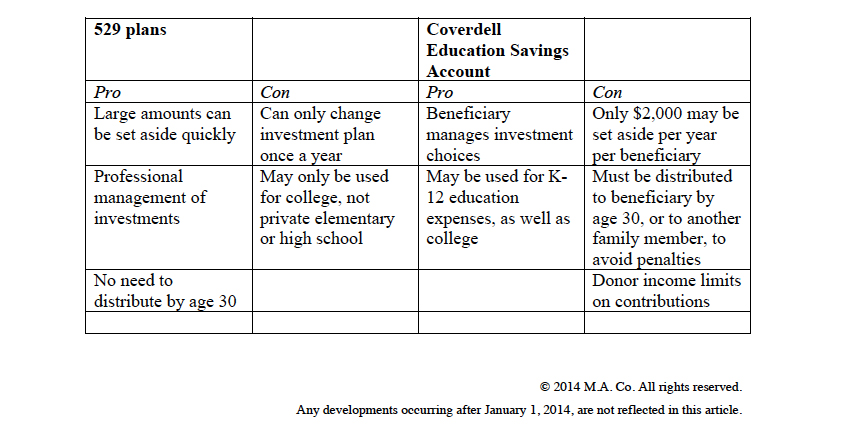
For those who are accumulating funds for a child’s or grandchild’s education expenses, there was good news in the American Taxpayer Relief Act of 2012, which was passed to avoid the “fiscal cliff” as this year started. The tax code provisions for the Coverdell Education Savings Account (ESA) were made permanent, removing a cloud of uncertainty. These accounts may be an alternative to or a supplement to a 529 college savings plan.
Contributions to 529 plans and ESAs are not tax deductible, but there is no tax as the income builds up in the account. Distributions from the plans are tax free if they are used for qualified education expenses. The definition of what qualifies is not the same for the two approaches.

ESAs have two advantages over 529 plans. First, qualified expenses are not limited to higher education, as with the 529 plan, but may also include tuition at private school as early as kindergarten. Second, where 529 plans are typically limited to just a few investments choices, with the money managed by the plan sponsor, there are no similar limitations for ESAs.

However, there are ESA disadvantages to consider also, where the 529 plan is superior. Most importantly, no more than $2,000 per year per student may be contributed to an ESA. Second, contributions must end when the beneficiary reaches age 18. Therefore, no more than $36,000 total may be set aside for one student, which almost certainly will fall far short of the financial need. Still, having a dedicated capital source that is growing tax free as one begins higher education is nothing to sneeze at.

A third problem is that contributions to ESAs are not permitted for those whose income is too high—modified adjusted gross income of $110,000 for singles, $220,000 for a married couple. No similar limitation applies to the 529 plan.

Successor beneficiaries
What if the beneficiary decides against college? The ESA accumulation may be rolled into another ESA for a family member of a beneficiary, or an new beneficiary may be designated for the 529 plan. The new beneficiary must be of the same or higher generation as the original beneficiary.
The ESA must be distributed by the time the beneficiary reaches age 30, or within 30 days after that date. The distribution may be in the form of a rollover to another family member. Amounts not rolled over and not used for qualified expenses are included in taxable income, and a 10% tax penalty applies. No such age limits apply to the 529 plan.

Start early
As valuable as the tax advantages of ESAs and 529 plans may be, the biggest advantage is starting early. The sooner one begins setting aside funds for a college education, the more time that capital has to grow into something significant.

ef


Do you have unclaimed property?

It might be a dormant bank or investment account, an individual stock, or an insurance check. It could be unused travelers’ checks or even a balance on a gift card.
Today some states with burgeoning deficits, hunting for sources of easy revenue in hard times, are becoming more aggressive in scooping up certain property when there’s been a dearth of activity in connection with it. What is scooped up can turn out to be no small line item in a budget: For example, seized property accounted for the third-largest source of revenue in Delaware in its last fiscal year.
What a state considers to be the necessary period of inactivity to permit seizure of property may surprise you. It’s often five years, but the trend is downward, and is as little as three years in some states.

Reclaiming seized property
Theoretically, states take possession of “abandoned property” to keep it safe until claimed, and they are required to seek out its owners. Some states take an aggressive approach to attempting to find owners and return their property. Others are relatively passive, so results vary. The percentages returned can run from nearly 50% (Iowa) to single digits (Delaware). An owner who discovers that property has been seized always can step forward and file with the state to reclaim it. But proving ownership generally requires filling out a great deal of paperwork—and then waiting, adding to the time that the asset doesn’t earn interest or appreciate in value as it might if the state hadn’t stepped in. If the property is stock or jewelry (typically, from a safe deposit box), it may be sold shortly after acquisition by the state.
There’s no time limit as to when an owner can claim his or her property. Heirs, in most cases, also have a right to make a claim, although that may prove especially difficult and time consuming.

Review and research
To avoid any unpleasant surprises, make small deposits to or withdrawals from accounts for which there has been no recent activity. Check up on accounts that grandparents or others may have opened for your children for college. And when you have joint accounts with senior family members who are not likely to have made any transactions recently, find out when the last one took place.
Visit www.missingmoney.com, the Web site of the National Association of Unclaimed Property Administrators. It’s a very practical and simple way to find out if there is money owed to you or your family. Unfortunately, not all states are in the NAUPA database, although more are joining, and the number is approaching 40. (To find out if your state participates go to www.missingmoney.com/Main/StateSites.cfm.)
But even if your state isn’t in the database, it’s still worth a visit to the Web site if you have lived in other states over the years. You’ve nothing to lose, and who knows how much to gain.

© 2014 M.A. Co. All rights reserved.
Any developments occurring after January 1, 2014, are not reflected in this article.